To Make a Donation, Please Click the Donate Box

Wednesday, 31 March 2010

Donations and Awareness Update

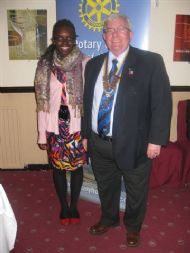
Pictured above, is myself with the Howe of Fife rotary club president, Dennis Beattie

The presentation that I made at the Howe of Fife Rotary club was a great success. The members were all very interested about cancer, and many of them were not aware how big a problem it is in the developing world. I am so happy to have been able to increase the awarness of cancer already.

The members of the Rotary Club were all very lovely, before I made my presentation, they treated me to a tasty meal. After my presentation, I was also given a very nice vote of thanks by Mr Andrew Kennedy who is also a vet.

 
More importantly, I am very greatful to the Rotary Club, for writing about my presentation on their website. If you would like to see what they have written please follow this link here: Howe of Fife Rotary Club: Sylvia's Presentation . They really have taken it in their hearts to increase the awareness of cancer in Uganda and I appreciate this so much.

At the end of the rotary meeting, I was also very kindly donated £40 towards my project. I am also extremely greatefull for this contribution and it means a lot to me.

I must say thank you very much to my academic tutor Dr Amanda Fleet for inviting me along to the Howe of Fife Rotary Club and giving me the amazing opportunity to make a presentation to its members.

What will I be doing in Uganda

Whilst in Uganda, I will be joining a group of volunteers with the Uganda Cancer Research Foundation. I will be participating in a programme which is split up into 3 mean areas.

  1. Outreach: We will visit rural villages, schools, rotary clubs and other community groups raising the awarness of cancer via presentations and workshops.We will tell people what cancer is, how it is detected and the importance of early diagnosis, both in terms of prognosis and in reducing treatment costs.
  2. Academic: I will help out as a research assistant by helping to collect data about cancer incidence throughout the country. The results of which, will show trends of cancer in Uganda. This is important in terms of public health planning. I will also help out with other ongoing research projects, which will give me an invaluable insight into the how academic research is conducted.
  3. Clinical: I will shadow doctors and conduct simple medical procedures at the Uganda Cancer Institute. I will also be mentoring Ugandan Medical student
As you can see, this is a very exciting project. It will involve many different skills. I will be working under conditions that I have never worked in before which I am looking forward to. I am eager to learn and what I will be exposed to whilst in Uganda will help my education tremendously. However, more importantly, I cannot wait to increase the awareness of Cancer throughout the Uganda.

Remember, if you would like to support my project, please leave a donation. Any amount will be greatly appreciated.

Friday, 26 March 2010

HIV and Cancer


As I said in a previous post, I am going to write about the links between HIV infection and cancer.

Earlier this week, when I made a presentation to the Howe of Fife rotary club, one of the members told me that they had no idea that HIV infection can increase the risks of cancer. This highlighted to me the importance of needing to increase the awareness of cancer. HIV infection rates in Sub Saharan Africa are extremely high, which results in millions of people being predisposed to many types of cancer. In addition, the introduction of better treatment for HIV positive individuals has increased their life expectancy, resulting in the incidence of certain cancers to increase.

There are several cancers which when present mark the progression of HIV into AIDS. These include:
  • Kaposi Sarcoma (KS)
  1. rare in the HIV negative population
  2. patients with HIV infection are 200-300 more likely to develop KS than those without
  3. the use of the newest HIV medication actually reduces the risk of developing KS
    • non-Hodgkin's Lymphoma (NHL)
    1.  also known as aids related lymphoma
    2. HIV infection variably increases the risk developing this cancer by between 40-400 times.
      • invasive cervical cancer. (ICC)
      1. although it is an AIDS defining cancer, the research linking ICC with HIV is still inconsistant
        There are also other cancers, which although are not AIDS defining, have higher incidence rates in those with HIV infection compared to those who how are HIV negative. Research has shown that HIV infected people have a 2-3 fold increase in developing these types of cancer. These cancers are often described as Non Aids defining, Aids Associated malignancies or opportunistic cancers. These include
        • Hodgkins Disease (HD)
        1. HIV infection increases the risk of developing HD by 7-11 times compared to the general population
          • Lung Cancer
          1. HIV infected patients are 2-7 times more likely to develop lung cancer compared to HIV negative individuals
          2. long term tobacco exposure is usually much lower in HIV infected patients as it is normally diagnosed at an earlier stage
          3. The most recent treatment for HIV has caused an almost 9 fold increase in the rates of lung cancer, however this is probably more due to the increased life expectancy.

            The prognosis cancer patients that are HIV postitive compared to those that are HIV negative tends to be much worse, irregardless of the type of cancer. This may be due to cancers being more aggressive in those that have compromised immune systems,. In addition, HIV patients, often present with much more advanced cancers at the time of diagnosis and at much younger ages.

            The exact causes and reasons why HIV infection increases the risks of cancer is stil unclear. However there are several different hypothesis. The main one due to the bodies own lack of immune response. It may also be that AIDS defining cancers are related to cancer promoting viruses such as HPV. Also, the increased rate of general infections might increase the risk of cancer. However, it may be that other risk factors such as multiple sexual partners, drug use, increased alcohol/tobacco consumption may be the cause for increased cancer rates among HIV infected individuals.

            Regardless of whether these cancers are directly related to HIV infection, treating cancer in HIV-positive patients remains a challenge because of drug interactions, compounded side effects, and the potential effect of chemotherapy on the patient.
            Monday, 22 March 2010

            Howe of Fife Rotary Club

            I have been given an amazing opportunity to spread the word of the Uganda Cancer Research Foundation at the Howe of Fife Rotary Club tomorrow evening. I am very excited about this. It will be great to increase the awareness of cancer in Uganda, and I will hopefully be able to make links with Howe of Fife Rotary Club and Rotary clubs in Uganda.

            Wednesday, 17 March 2010

            Many thanks to my University Careers Centre and Travel Centre

            Last week, I was selected to give a 3 minute presentation to a commitee of representatives from my university's Careers Centre and Travel Service about my Summer Project. I was very happy to be given this opportunity and today I gave my presentation. I was so happy when later on today I received a wonderful e-mail saying that I was the chosen candidate for the travel bursary. Subject to satisfactory completion of the University Risk Assessment forms, I will be given £300 towards my travel costs.

            This is a very large contribution and I am so happy and grateful for being awarded this bursary. I really appreciate it that my university has shown me this support towards my summer project and to UCRF.

            Sunday, 28 February 2010

            Support me to Fight Cancer in Uganda; with your support, it can be done, and it WILL be done

            Pilot Project to Collect National Cancer Status Data in Uganda

            This summer, I will be volunteering with UCRF to work on the Cancer Survey Project.  The Cancer Survey Project is part of UCRF's Research and Education Section's Plan to obtain accurate cancer data for Uganda.

            Accurate data about disease incidence (new cases) and prevalence (existing cases) are vital for planning public health programs, especially for cancer. Data are sparse on cancer incidence and prevalence in Uganda, hampering the design and delivery of health education messages that stress risk factors, early detection or prevention, and the planning for treatment of cancer in the face of scarce health resources.

            A historical cancer survey conducted in the 1960s (Templeton and Hutt, 1973) demonstrated that cancer diagnosis, although seeming to be incomplete, it was not uncommon. Risk for cancer increased with age, but cancers diagnosed appeared to be different by geography. For example, stomach and oesophageal cancer appeared more frequent in the Western regions, penile cancer more frequent in Buganda, and Burkitt lymphoma and Kaposi sarcoma more frequent in West Nile than elsewhere. These differences were due to differences in access to care and to some risk factors for cancer being common in some but not other areas. No cancer survey has been conducted in Uganda since.

            Contemporary cancer data comes from the Kyaddondo County Registry, based at Makerere College of Health Sciences, but this covers only 3% of Uganda’s population in Kampala District and parts of Wakiso and Mpigi districts (Wabinga, 1993), and is not nationally representative. Nationally representative data are needed to inform policy and public health efforts.

            UCRF will conduct a National Cancer Status Survey for cancers diagnosed over the past 2-5 years at regional and district centres in three regions of Uganda, excluding the central region, which is covered by the Kyaddondo Cancer Registry. The survey will provide base-line data and demonstrate feasibility a Cancer Surveillance Program in Uganda. The survey will take 4-8 weeks during summer and will be the basis for a preliminary Uganda Cancer Status Report.

            Cancer in Uganda

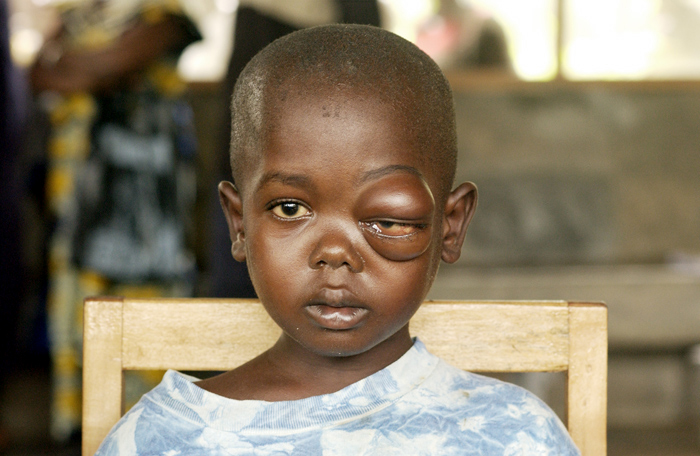
            Young child who is suffering from Burkitts Lymphoma, one of the most common childhood cancers in Uganda


            It may be hard to believe that cancer can be a major problem in countries with high rates of infant mortality, malnutrition and infectious diseases. However, recent research has revealed that nothing could be farther from the truth. Cancer is increasingly common among African children and adults alike. 
            This has been compounded by the exponential spread of HIV over the past few decades. The rates of some cancers have increased substantially in many African regions since the start of the HIV epidemic. I will discuss the relationship between HIV infection and cancer in another post. 
             
            Although significant resources have been applied to combating HIV, malaria, TB, poverty and malnutrition, little has been done to explore or address the problem of cancer in Africa. This is especially evident East African. Uganda, for example has a population of over 31 million people and only two practising oncologists. Contrast this with my home town Aberdeen which has a population of about 250,000 people and two appointed oncologists (data from RCP London, click here). Uganda's 2 oncologists do not have the time to collect data about cancer diagnosed by non-specialist doctors.  UCRF will meet this need with the help of volunteers, a team that I will be joining this summer. I have a love for this challenging work because it will involve reviewing papers, which I hope will have an added benefit of highlighting the value of keeping accurate records.

            As a consequence, even patients with curable cancers go untreated. This is due to a combination of their inability to afford diagnostic tests, basic chemotherapy or even pain-relieving medications and a scarcity of both human and medical resources. This not only causes an inordinate amount of individual suffering but also is an increasing burden on society.

            take a moment to think about this, if you want to help scroll down to the bottom of my page and please make a donation.

            For more information about cancer and a link to where some of the statistics came from please click here