- St Andrews University for awarding me the Ede and Ravenscroft Travel Scholarship worth £500
- Dr John Calder trust for very generously donating me £300
- Mr C Williamson from the Williamson Memorial Trust who gave a wonderful donation of £200
Thursday, 29 April 2010
Fundraising Update
Over the past few weeks, my fundraising total has almost doubled. This is thanks to the extremely generous support of several people.

Friday, 9 April 2010
Wrap Up Africa
Final Piece from Amanda Bontecou on Vimeo.
Wrap up Africa is another charity in Uganda which helps cancer patients and their family. I volunteered with them when I was in Uganda in 2007. It is a great charity and they do some amazing work. Please watch this short video which tells you abouts some of the problems that patients have in Uganda and also how you can help. If you would like to visit their website click on the following hyperlink: www.wrapupafrica.com
Wednesday, 7 April 2010
Fundraising Update
I got 2 exciting letters in the post today.
One from the Southdown Trust saying that they would like to donate £50 to my project and another one from the Lethendy Charitable Trust saying that they would like to invite me for an Interview.
This is great news and brings me even closer to my target. I would like to take this 1st opportunity to say thank you to the Southdown Trust for their great generosity and to the Lethendy Charitable trust for showing interest in my project and inviting me for an Interview to tell them more about what I will be doing.
One from the Southdown Trust saying that they would like to donate £50 to my project and another one from the Lethendy Charitable Trust saying that they would like to invite me for an Interview.
This is great news and brings me even closer to my target. I would like to take this 1st opportunity to say thank you to the Southdown Trust for their great generosity and to the Lethendy Charitable trust for showing interest in my project and inviting me for an Interview to tell them more about what I will be doing.
Friday, 2 April 2010
A Sad Story

On the UCRF home page, I read this very sad story. Through the Outreach part of the UCRF programme which I will be participating on, I hope to reduce such sad and avoidable deaths.
The gentleman who's legs are pictured died without Doctors telling him that he had Cancer!
This man had suffered from swollen feet and a feeling of weakness for a long time. Despite numerous visits to the doctor, he was just told that he had little blood. When infact he had been suffering from a kidney obstruction, something that nobody had informed him. He had to go for short calls frequently, and doctors had been treating him for bladder infections for many years. A few days from his death bed, a doctor advised him that he needed a blood transfusion, hemodialysis, and a biopsy on his prostate (empulunguuse). Despite the fact that he was in great pain, he was still not referred to a hospice.
A few hours to this man's death, his sister, who had lost her husband to cancer many years before arrived at the hospital to see him. Being the same hospital where her husband died from (Mulago) and noting the frenzy of activities by relatives to find money for hemodialysis, she called a junior doctor to the side and asked three questions:
1) Would the treatment recommended cause her brother to walk out of the hospital ALIVE?
- the good junior doctor answered NO.
2) Were the doctors doing anything they thought would make the patient live?
- the good junior doctor answered NO....
3) Were they doing anything at the hospital that could not be done at home?
- the good junior doctor answered NO.
Recalling her own experience at the hospital mortuary when they waited for her husband's body to be released to them, the 80 year old old womon confered with the man's family and friends that he should be taken to die at home, especially because there was no provision for palliative care for him in Kampala.
Whilst this was happening, the man slipped into comma, which the junior doctor explained was because his kidneys had failed. The man never acknowledged the touch from his sister as she told him:
"we are taking you home where you will join our father and our other brother".
They travelled over 120 miles back to the village where very sadly he died just minutes after the end of the long journey. At least he was at his house surrounded by relatives and friends. They were all able to say goodbye but no one could tell whether he had heard them.
This old man had just made 60 years! Within a week, his mother who had defied death thus far-gave up her ghost! Clearly, it was too much for her
More than 20,000 people attended his funeral, all were sad about his death.
- Nobody was told about cancer.
- None of them were told that it was a preventable cause of death.
- None of them were told to do something about their own risk.
Some of the people may even be enduring the sad experience of this man. This is why the story was shared with UCRF, and now with you. From the depths of this sadness, may be a lesson which can be made so that others can be saved of a painful death without knowledge of why, or even the opportunity to put their lives in order.
This man saw many people about his problem. Some were proper doctors, others were not. Somehow, he died without knowing why he was dying. He had symptoms that shouted his diagnosis, and yet it he was not told. ....
maybe there other stories like this..., but this was one tough to take and remains tough for his family and friends to take.
Wednesday, 31 March 2010
Donations and Awareness Update
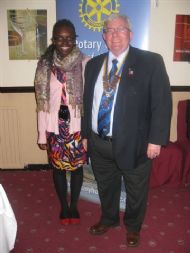
The presentation that I made at the Howe of Fife Rotary club was a great success. The members were all very interested about cancer, and many of them were not aware how big a problem it is in the developing world. I am so happy to have been able to increase the awarness of cancer already.
The members of the Rotary Club were all very lovely, before I made my presentation, they treated me to a tasty meal. After my presentation, I was also given a very nice vote of thanks by Mr Andrew Kennedy who is also a vet.
More importantly, I am very greatful to the Rotary Club, for writing about my presentation on their website. If you would like to see what they have written please follow this link here: Howe of Fife Rotary Club: Sylvia's Presentation . They really have taken it in their hearts to increase the awareness of cancer in Uganda and I appreciate this so much.
At the end of the rotary meeting, I was also very kindly donated £40 towards my project. I am also extremely greatefull for this contribution and it means a lot to me.
I must say thank you very much to my academic tutor Dr Amanda Fleet for inviting me along to the Howe of Fife Rotary Club and giving me the amazing opportunity to make a presentation to its members.
What will I be doing in Uganda
Whilst in Uganda, I will be joining a group of volunteers with the Uganda Cancer Research Foundation. I will be participating in a programme which is split up into 3 mean areas.
Remember, if you would like to support my project, please leave a donation. Any amount will be greatly appreciated.
- Outreach: We will visit rural villages, schools, rotary clubs and other community groups raising the awarness of cancer via presentations and workshops.We will tell people what cancer is, how it is detected and the importance of early diagnosis, both in terms of prognosis and in reducing treatment costs.
- Academic: I will help out as a research assistant by helping to collect data about cancer incidence throughout the country. The results of which, will show trends of cancer in Uganda. This is important in terms of public health planning. I will also help out with other ongoing research projects, which will give me an invaluable insight into the how academic research is conducted.
- Clinical: I will shadow doctors and conduct simple medical procedures at the Uganda Cancer Institute. I will also be mentoring Ugandan Medical student
Remember, if you would like to support my project, please leave a donation. Any amount will be greatly appreciated.
Friday, 26 March 2010
HIV and Cancer

As I said in a previous post, I am going to write about the links between HIV infection and cancer.
Earlier this week, when I made a presentation to the Howe of Fife rotary club, one of the members told me that they had no idea that HIV infection can increase the risks of cancer. This highlighted to me the importance of needing to increase the awareness of cancer. HIV infection rates in Sub Saharan Africa are extremely high, which results in millions of people being predisposed to many types of cancer. In addition, the introduction of better treatment for HIV positive individuals has increased their life expectancy, resulting in the incidence of certain cancers to increase.
There are several cancers which when present mark the progression of HIV into AIDS. These include:
- Kaposi Sarcoma (KS)
- rare in the HIV negative population
- patients with HIV infection are 200-300 more likely to develop KS than those without
- the use of the newest HIV medication actually reduces the risk of developing KS
- non-Hodgkin's Lymphoma (NHL)
- also known as aids related lymphoma
- HIV infection variably increases the risk developing this cancer by between 40-400 times.
- invasive cervical cancer. (ICC)
- although it is an AIDS defining cancer, the research linking ICC with HIV is still inconsistant
- Hodgkins Disease (HD)
- HIV infection increases the risk of developing HD by 7-11 times compared to the general population
- Lung Cancer
- HIV infected patients are 2-7 times more likely to develop lung cancer compared to HIV negative individuals
- long term tobacco exposure is usually much lower in HIV infected patients as it is normally diagnosed at an earlier stage
- The most recent treatment for HIV has caused an almost 9 fold increase in the rates of lung cancer, however this is probably more due to the increased life expectancy.
The prognosis cancer patients that are HIV postitive compared to those that are HIV negative tends to be much worse, irregardless of the type of cancer. This may be due to cancers being more aggressive in those that have compromised immune systems,. In addition, HIV patients, often present with much more advanced cancers at the time of diagnosis and at much younger ages.
The exact causes and reasons why HIV infection increases the risks of cancer is stil unclear. However there are several different hypothesis. The main one due to the bodies own lack of immune response. It may also be that AIDS defining cancers are related to cancer promoting viruses such as HPV. Also, the increased rate of general infections might increase the risk of cancer. However, it may be that other risk factors such as multiple sexual partners, drug use, increased alcohol/tobacco consumption may be the cause for increased cancer rates among HIV infected individuals.
Regardless of whether these cancers are directly related to HIV infection, treating cancer in HIV-positive patients remains a challenge because of drug interactions, compounded side effects, and the potential effect of chemotherapy on the patient.
Subscribe to:
Posts (Atom)